
When you're pinning it down a rocky descent or navigating a technical trail, the last thing you want to worry about is whether your helmet is up to the task. If you're torn between 360 Turbine Technology and MIPS, the choice comes down to how they manage impact: 360 Turbine uses flexible gel discs to absorb both rotational and low-velocity linear forces, while MIPS utilizes a sliding internal layer specifically designed to redirect rotational energy. Both are top-tier, but Leatt’s Turbine system offers a slimmer profile and better low-speed cushioning.
Why do we need specialized brain protection anyway?
As mountain bikers and riders, we’ve grown up with the standard foam bucket. For decades, helmets were designed to do one thing: stop your skull from cracking during a direct, "lawn dart" style impact. While EPS (expanded polystyrene) foam is great at crushing to absorb that big hit, it doesn't do much for the "sloshing" effect inside your head.
When you hit the ground at an angle, which is almost always how it happens, your head undergoes a rapid rotation. This shearing force is what causes concussions and more severe traumatic brain injuries (TBI). We’ve learned that even if the helmet stays intact, the brain’s sudden twist inside the cerebrospinal fluid can cause real damage.
That’s where these two technologies step in. They aren't just "extra padding"; they are mechanical systems designed to decouple the helmet's shell from your head.
Understanding MIPS and Rotational Protection
MIPS, or Multi-directional Impact Protection System, is the industry veteran. You’ve likely seen that distinctive yellow plastic liner inside everything from entry-level commuter lids to pro-level downhill full faces. Developed by biomechanical specialists at the KTH Royal Institute of Technology, MIPS is built on a "slip-plane" concept.
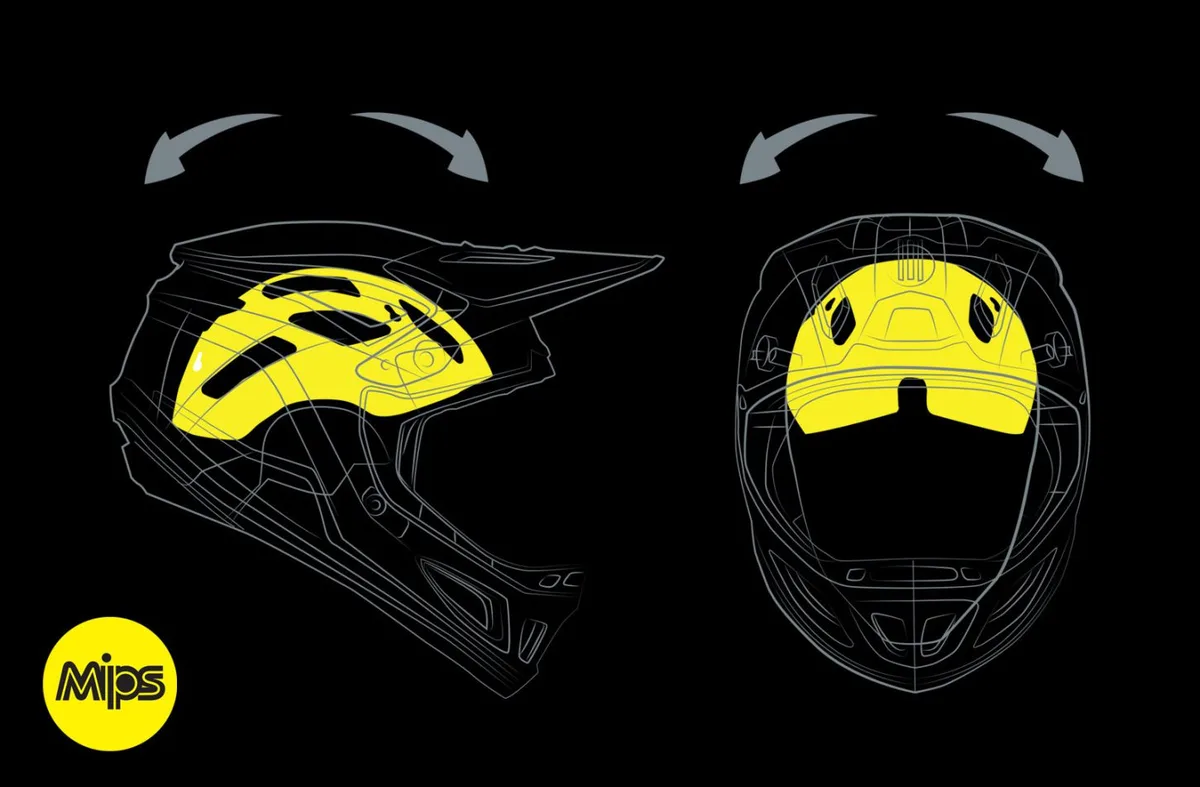
Inside a MIPS-equipped helmet, there is a thin, low-friction layer held in place by elastomeric anchors. When you hit the dirt at an angle, these anchors stretch, allowing the outer shell of the helmet to slide independently of your head by about 10 to 15 millimeters. It sounds tiny, but that fraction of a second and that small movement significantly reduce the rotational torque transferred to your brain.
However, MIPS isn't without its quirks. Because it involves a literal plastic layer inside the helmet, it can sometimes interfere with ventilation if the ports aren't perfectly aligned. Some riders also complain about "hair pulling" or a slightly squeaky fit.
That said, its track record is impeccable, and it is the most widely tested third-party safety system on the market.
The Leatt Approach: What is 360 Turbine Technology?
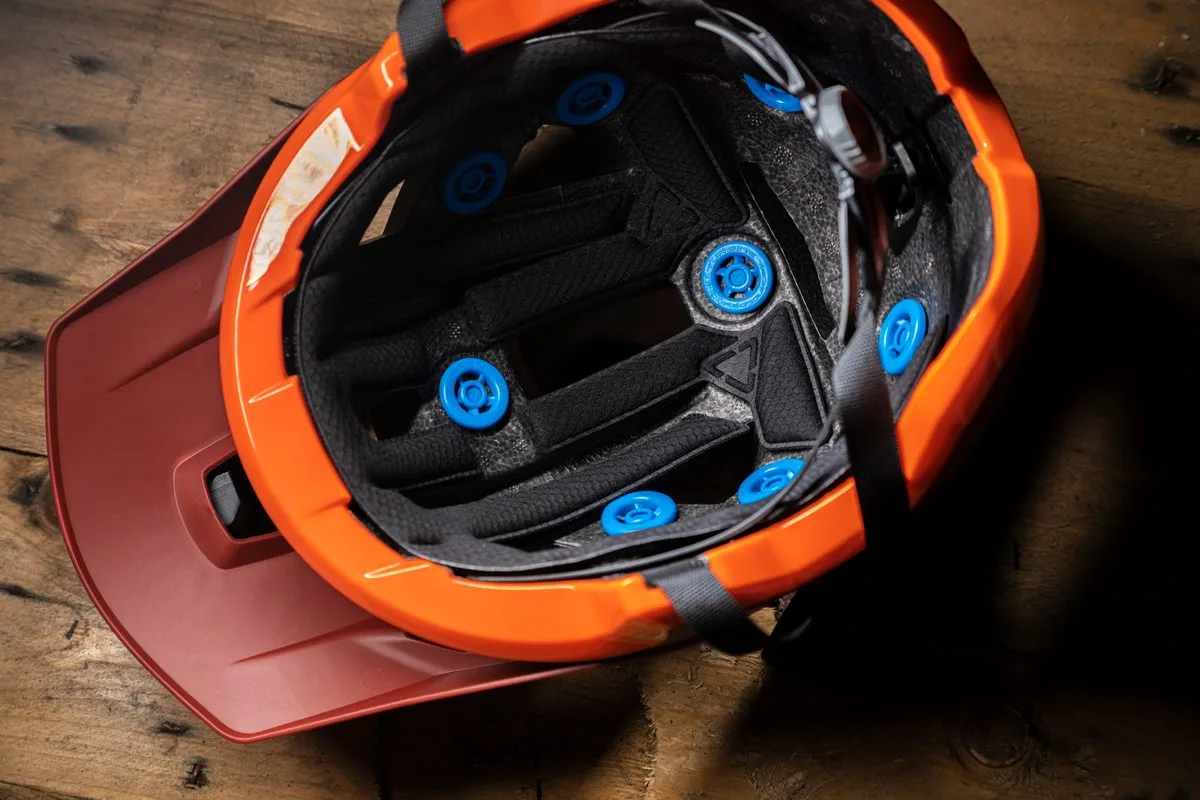
Leatt took a different path. Instead of a full-wrap plastic liner, they developed 360 Turbine Technology. If you look inside a Leatt helmet, you’ll see small, blue, circular discs that look like tiny rubber donuts.
These are made from Armourgel, a non-Newtonian material that is soft to the touch but hardens instantly upon impact.
These turbines are strategically placed throughout the helmet's interior, sitting directly against your head. They serve a dual purpose that MIPS generally doesn't address as directly:
- Rotational Mitigation: Like MIPS, the turbines allow the helmet to move slightly in any direction (360 degrees) upon impact, shearing to reduce rotational acceleration.
- Low-Velocity Linear Absorption: Because the turbines are squishy, they compress during low-speed impacts where the hard EPS foam wouldn't even budge. This is huge for those "nuisance" falls that still leave you seeing stars.
360 Turbine Technology vs MIPS: Side-by-Side Comparison
To help you decide which system fits your riding style, we’ve broken down the key differences in how they feel and function on the trail.
| Feature | 360 Turbine Technology | MIPS (Standard) |
|---|---|---|
| Primary Material | Armourgel (Non-Newtonian) | Low-friction Polycarbonate |
| Mechanism | Deformable/Shearing Discs | Sliding Slip-Plane Liner |
| Linear Protection | Excellent for low-G impacts | Minimal (Relies on EPS foam) |
| Weight Impact | Negligible | 20g – 45g (Approx) |
| Ventilation | High (Minimal obstruction) | Variable (Liner can block vents) |
| Fit Feeling | Soft "pressure points" | Smooth, snug wrap |
| Durability | Discs are permanently bonded | Liner/Anchors are replaceable |
My Personal Experience on the Trails
I've spent years swapping between MIPS-equipped lids and Leatt’s Turbine helmets, and I’ve had my fair share of "dirt naps" in both. One thing I immediately noticed with 360 Turbine Technology is the cooling. Because there isn't a solid sheet of plastic between my scalp and the air vents, I find Leatt helmets tend to exhaust heat much faster on slow, grinding climbs.
However, fit is subjective. I’ve talked to riders who prefer the "cradle" feeling of a MIPS liner, as it feels like the helmet is more securely wrapped around the crown of the head. In contrast, the Turbines feel like small, soft cushions.
If you have a sensitive scalp, you might feel the individual discs, though I find they disappear once you start moving.
In a crash, a low-speed over-the-bars moment in a rock garden, I was wearing a 360 Turbine helmet. I hit my head just hard enough to dent the shell but not hard enough to fully compress the EPS. I walked away without the typical "bell-rung" headache.
I attribute that largely to the gel discs absorbing that initial "soft" hit that MIPS might have just passed through to my skull.
If you are currently looking at your gear and realizing it's time for an upgrade, checking your routine upkeep is a great way to ensure all your equipment, not just your helmet, is ready for the season.
Which One Should You Choose?
There is no "wrong" answer here, as both technologies significantly outperform a standard foam helmet. However, certain riders will gravitate toward one over the other.
Choose MIPS if:
- You want the most widely tested and "gold standard" technology.
- You prefer a helmet that feels like a solid, unified piece.
- You are buying a brand like Giro, Bell, or Specialized (who heavily utilize MIPS).
- You want a system that is easily inspected for damage (you can see the plastic anchors).
Choose 360 Turbine Technology if:
- Heat management is your priority. The lack of a liner makes these some of the best-ventilated helmets available.
- You worry about low-speed concussions. The gel discs provide a layer of "soft" protection that hard foam and plastic liners simply cannot match.
- You want a lighter, lower-profile helmet. Because the turbines are integrated into the padding space, the helmet shell can often be made slightly smaller.
Safety Rules for Any Helmet
Regardless of whether you choose the blue discs or the yellow liner, the technology only works if you follow these basic safety principles:
- The Five-Year Rule: EPS foam degrades over time due to UV exposure and sweat. Even if you haven't crashed, replace your lid every five years.
- One and Done: Both MIPS and 360 Turbine are designed to survive impacts, but the EPS foam is not. If you have a significant crash, the helmet is trash.
- Check the Snugness: A rotating helmet is useless if it’s so loose it slides off your forehead. Use the dial fit system to ensure it doesn't move when you shake your head.
- No Modifications: Never drill holes or trim the MIPS liner to "improve airflow." You’ll compromise the slip-plane and void the safety rating.
The Future of Brain Protection
We are seeing a massive shift in how companies approach safety. We've moved past the era of "one size fits all" protection. Organizations like Virginia Tech’s Helmet Lab have brought independent testing to the forefront, and both Leatt and MIPS-equipped helmets consistently rank at the top of their safety charts.
As we look forward, we might see a hybrid of these systems. Some manufacturers are already experimenting with "MIPS Spherical," which uses two layers of EPS foam acting like a ball-and-socket joint, removing the plastic liner entirely. This shows that the industry is leaning toward the "integrated" approach that Leatt pioneered with their turbines.
When you're out there, whether you're chasing a PR or just enjoying the scenery, knowing you have a "second skull" that handles rotation can give you the confidence to progress. Just remember that even the best top-rated brewers or most expensive gear won't help if you don't wear it correctly.
FAQ
Does 360 Turbine Technology last as long as MIPS?
Yes. The Armourgel used in Leatt’s turbines is incredibly durable and resistant to temperature changes. While MIPS anchors can occasionally snap during a heavy cleaning or rough handling, the turbines are generally bonded very securely to the helmet’s interior.
Can I add MIPS to a non-MIPS helmet?
Absolutely not. MIPS is an integrated safety system that requires specific internal clearances and anchor points designed during the manufacturing process. Attempting to DIY a safety system is a recipe for disaster.
Is Leatt the only company using 360 Turbine?
Yes, 360 Turbine Technology is proprietary to Leatt. Other brands have similar "pod" based systems (like 100%'s Smartshock), but the specific Armourgel turbine design is unique to Leatt.
Does MIPS make a helmet smaller?
Actually, the opposite. Because the MIPS liner takes up about 0.5mm to 1mm of space, manufacturers often have to slightly upsize the shell or thin the padding to accommodate it. This is why some people find they are "between sizes" in MIPS helmets.
Which is better for kids?
Both are excellent. Kids are more susceptible to concussions from lower-force impacts, so the 360 Turbine’s ability to absorb low-G hits is a strong selling point. However, MIPS is available in a much wider variety of youth-specific helmet brands.
In the end, the "best" helmet is the one that fits your head shape perfectly and that you actually enjoy wearing. Whether you go with the proven sliding layer of MIPS or the innovative gel discs of Leatt's 360 Turbine, you're making a massive upgrade over a standard helmet. Gear up, stay safe, and we'll see you on the trails!

I’m the tech enthusiast behind FixTechEasy. I know how stressful it is when your technology doesn’t cooperate. My goal here is to take the headache out of troubleshooting by breaking down complex tech problems into simple, easy-to-follow steps. From quick fixes to deep-dive guides, I’m here to help you get back to what matters most. Let’s get your tech working for you, not against you.